Nursery Safety & Mattress Fit
Mini Crib Mattress Fit: Measuring for a Snug, Secure Setup
A mini crib mattress is not a universal object, despite the tidy confidence of the word “mini.” Crib interiors vary, and a mattress that seems close enough in a shop or on a screen may leave a gap in the frame. Before choosing one, measure the crib’s interior, check the manufacturer’s requirements, and confirm the finished fit in the assembled crib.
Published November 4, 2026
Why fit deserves its own checklist
In a nursery, the most consequential details are often the least picturesque. A carefully chosen finish, a compact footprint, a pleasing arrangement of furniture: these are the things a room announces. Mattress fit is quieter. It is established by dimensions and confirmed at the edges, where the mattress meets the crib frame. That small boundary matters because an infant’s sleep surface should be firm, flat, and properly matched to the crib—not improvised from a product label or an assumption about standard sizing.
“Mini crib” describes a general category, not a promise that every mini crib has the same interior measurements. Models differ, and even the terminology used by manufacturers may not tell you enough to select a mattress confidently. The relevant dimensions are the inside measurements of the particular crib and the stated dimensions of the mattress. Both need to be checked against the crib maker’s instructions.
A mattress that is too small may leave space around its perimeter. A mattress that is too large may buckle, press against the sides, or fail to lie flat. Neither problem is solved by pushing the mattress into place or dressing it with extra layers. The sensible sequence is plain: identify the crib model, find its current instructions, measure the interior, compare the figures, and then check the fit in the assembled crib.
This is practical guidance, not a substitute for the crib manufacturer’s directions or current safe-sleep recommendations. When instructions differ, follow the guidance supplied for the specific crib and ask the manufacturer or a qualified safety professional if anything remains uncertain.
Start with the crib, not the shopping label
Before browsing for an organic mini crib mattress, look for the crib’s model name and number. They may appear on a label attached to the frame, in the assembly paperwork, or in the original order records. Use that information to locate the manufacturer’s instructions, including any specified mattress size or compatible mattress models. Keep the documentation nearby: it is more authoritative than a retailer’s broad category name.
Then examine the crib itself. If it is new, assemble it exactly as directed before making a final fit assessment. A frame that has not been assembled, tightened, or squared as intended may not represent the dimensions it will have in use. If the crib is secondhand, confirm that its model and instructions can be identified, inspect it for damage or missing parts, and check whether any safety notices or recalls apply. Do not rely on a mattress to compensate for a bent, unstable, or incomplete frame.
Measure the interior opening where the mattress rests. Do not measure the outside of the crib, the length of a removable mattress support, or the area visible above a raised rail. The useful measurements are the inside length and inside width of the mattress compartment. If the frame is not perfectly uniform, take measurements in more than one place—near each end and through the middle—and note the smallest usable interior dimensions. Record the units, too. Inches and centimetres are both legitimate; a forgotten conversion is not.
A tape measure should sit straight along the interior surfaces rather than bowing across the opening. Measure from the inside face of one side to the inside face of the opposite side, then repeat in the other direction. If the manufacturer provides a required mattress size or a precise fit instruction, treat that information as essential rather than optional. Your measurements are a cross-check, not permission to disregard the product’s specifications.
How to measure and compare dimensions
Write down three pieces of information before you compare products: the crib’s model, the crib’s required mattress dimensions (if specified), and your measured interior length and width. Then read the mattress listing or its label for its actual length, width, and thickness. A phrase such as “fits mini cribs” is less useful than a clear dimension and compatibility statement. If dimensions are missing or ambiguous, contact the manufacturer before buying.
The Naturepedic Organic Mini Crib Mattress is listed at approximately 23.5 by 37.5 inches and 3 inches thick. Those figures provide a reference point, not a guarantee that it will fit every crib marketed as mini. Compare them with the instructions and interior measurements for your own model. Confirm the measurement conventions with the product maker if the listing does not make clear whether the stated dimensions are exact, approximate, or subject to normal manufacturing variation.
It can help to make a simple comparison table before ordering:
- Crib model: record the make and model number.
- Required mattress size: copy the dimensions or compatible-mattress guidance from the crib instructions.
- Interior opening: record the smallest measured length and width, along with the measurement units.
- Mattress size: note the manufacturer’s stated length, width, and thickness.
- Compatibility: verify that the mattress maker identifies it as suitable for the crib, where applicable.
Do not compare only one dimension. A mattress may have the right length but be too narrow, or the right width but too long. Thickness also matters: the crib’s instructions may specify a maximum, and the mattress must lie flat on its support. Adding a topper or other padding can alter the sleep surface and is not a way to correct a mismatch. Use only the mattress and components permitted by the crib maker.
When measurements appear close but not identical, resist the temptation to make your own tolerance rule. Different frames and mattress constructions may behave differently, and a rounded number on a web page may conceal detail. Ask the crib or mattress manufacturer to clarify compatibility rather than deciding that a small difference is automatically harmless.
Check the fit after the mattress arrives
Packaging can make a mattress seem more definite than it is. Remove it as directed, allow it to settle if the manufacturer recommends doing so, and place it on the crib support in the orientation specified. It should lie flat and fit within the frame without being forced, folded, or bent. Check along all four sides and at each corner, not just the edge nearest the room.
Look for visible spaces between the mattress and the crib sides. A quick visual inspection is useful, but it does not replace the crib maker’s fit test or instructions. If the manufacturer supplies a method for assessing gaps or fit, follow that method exactly. Do not invent a test based on a household object or assume a gap is acceptable because it is hard to notice from across the room.
Also confirm that the mattress does not ride up along the frame or appear compressed at the edges. It should remain level on its support. If it bows, bunches, or requires pressure to fit, stop using it in that crib and contact the manufacturer or retailer about the mismatch. Keep the packaging and order details until the fit is confirmed, in case a return or exchange is needed.
Recheck the arrangement after any change that could affect it: moving or reassembling the crib, adjusting a mattress support, replacing a mattress, or changing a component. A fit that was right in one configuration should not be assumed right in another. Follow the crib’s instructions for every adjustment, including the appropriate mattress-support position as the child grows.
The mattress is one part of a safe sleep space
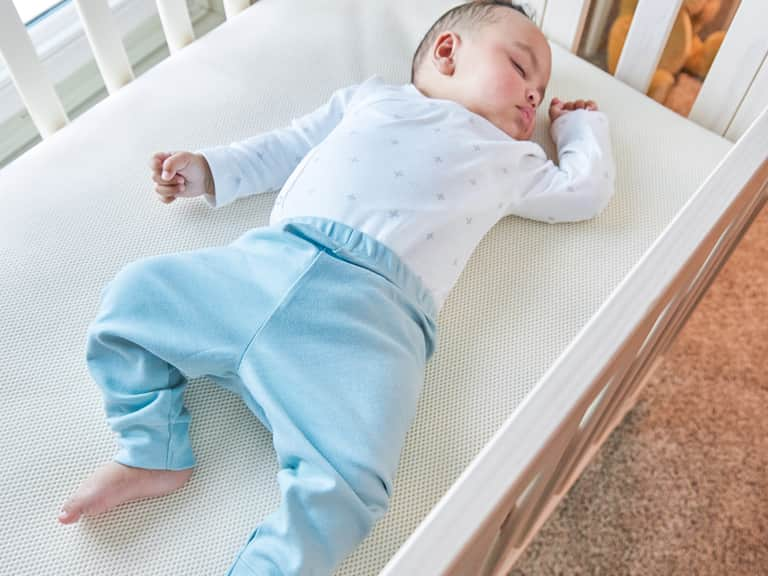
Fit is central, but it is not the entire question. For infant sleep, use a firm, flat mattress intended for the crib, covered only by a tightly fitted sheet designed for that mattress. Keep the sleep space free of loose bedding, pillows, padded items, positioners, and other objects unless a qualified medical professional has advised otherwise for a specific circumstance. Place the baby on their back for sleep and follow current guidance from trusted public-health and pediatric sources.
For a crib mattress, “comfortable” should never be taken to mean soft or cushioned. A surface that feels plush to an adult’s hand is not necessarily appropriate for an infant. The mattress should be firm and level, and the fitted sheet should be the correct size and remain securely in place. Do not stack sheets, add a comfort layer, or tuck spare fabric around the mattress to hide a gap. Those additions can create new hazards instead of solving the original problem.
Material and care features may also matter to families, but they come after compatibility and safe use. The Naturepedic Organic Mini Crib Mattress is described as having organic cotton materials, a breathable cover, a waterproof surface, and a firm support design. Its listed certifications and construction details may help a caregiver understand the product, but no material claim overrides the need to follow the crib’s specifications and confirm the physical fit.
If considering this model, review the Naturepedic Organic Mini Crib Mattress product information, then verify its approximately 23.5-by-37.5-inch dimensions against the crib manufacturer’s requirements. Product measurements are a starting point for comparison; the final decision belongs to the fit check in the actual crib.
Common mistakes—and the more reliable alternative
- Assuming “mini” means one standard size. Instead, identify the crib model and check its instructions.
- Measuring the outer frame. Measure the interior opening where the mattress sits.
- Checking only length or width. Record both dimensions, plus thickness and any manufacturer limits.
- Trusting a broad compatibility phrase alone. Find actual dimensions and verify them with the crib maker’s guidance.
- Forcing a close fit. A mattress should not need to be bent, compressed, or wedged into place.
- Filling a gap with extra material. Do not use rolled cloth, padding, or a topper to make an incompatible mattress appear to fit.
- Skipping a second check after assembly or adjustment. Reassess fit whenever the crib configuration changes.
A calm, repeatable measuring routine
For many caregivers, the most reassuring approach is also the least elaborate. Find the crib manual. Measure the interior opening in two directions. Compare those figures with the crib’s stated mattress requirements and the dimensions of the mattress under consideration. When a product description says “approximately,” treat the number as a reference that needs confirmation, not as a precise promise. If the figures conflict or leave room for doubt, pause and ask the manufacturer.
Once the mattress is in hand, place it on the correctly assembled support, inspect the edges and corners, and make sure it lies flat without force. Use the fitted sheet specified for the mattress, and keep the crib’s sleep space clear. These steps are modest, but their order matters: the best bedding choice begins with the crib’s actual dimensions, not with a decorative scheme or a product name.
A well-measured nursery is not a contest in precision for its own sake. It is a room in which ordinary tasks—changing a sheet, checking a corner, settling a child—can happen without avoidable uncertainty. The word “mini” may be convenient shorthand. For safety, the measurements are the more dependable language.
Mini crib mattress fit: quick checklist
- Identify the crib make and model; locate its current manual.
- Measure the interior length and width where the mattress rests.
- Compare both measurements with the crib’s mattress requirements and the mattress maker’s dimensions.
- Check thickness limits and any specific compatibility instructions.
- After assembly, confirm the mattress lies flat, fits without force, and leaves no unsafe gaps.
- Use a correctly sized fitted sheet and follow current infant safe-sleep guidance.
- If anything is unclear, contact the crib or mattress manufacturer before use.